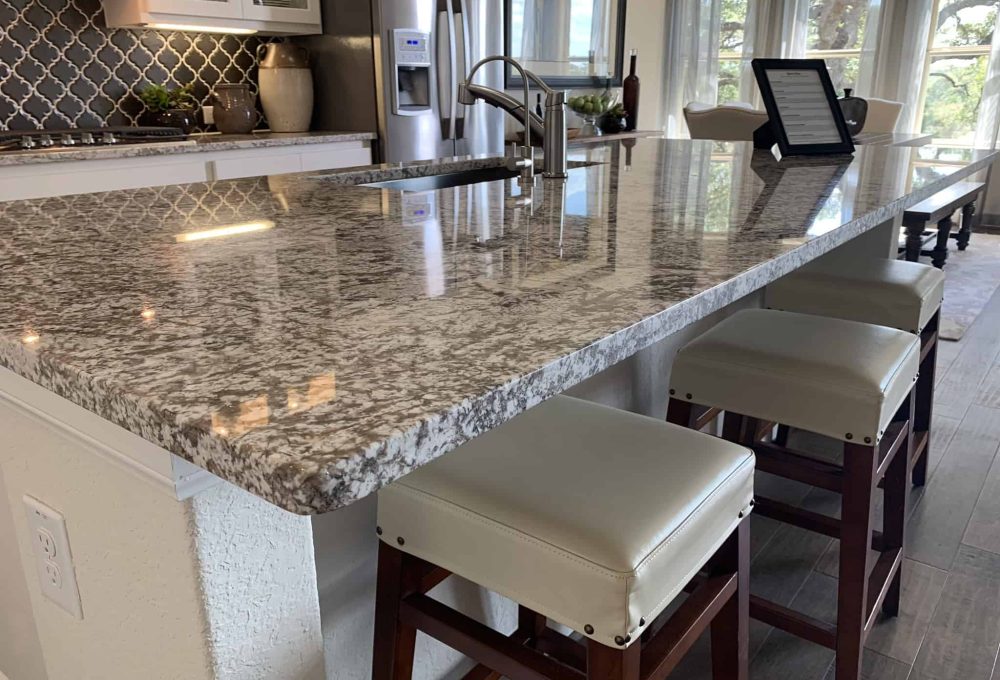
A porous countertop has microscopic openings in its surface where liquids, oils, and bacteria can settle if given the chance. These openings come from how the material formed. Natural stone cools, compresses, and crystallizes underground over millions of years, and that process leaves tiny gaps between mineral grains.
Those gaps are not visible to the naked eye in most cases, but they are there, and they determine how a countertop behaves in daily use. At our design center in Somerset, we walk homeowners through this distinction constantly because it affects far more than looks. It shapes how a countertop is cared for and how it holds up over years of cooking, entertaining, and everyday spills.
Our granite countertops and quartzite countertops are both quarried from the earth, and both are naturally porous. Granite forms from cooled magma or lava, while quartzite begins as sandstone that gets transformed by heat and pressure over time. The result in both cases is a dense, hard surface with small pores scattered throughout.
Because these stones are porous, a sealer is applied to help resist staining. The sealer fills the pores near the surface so liquids bead up instead of soaking in. It does not make the stone impervious, and the degree of porosity varies from one slab to the next depending on the color and mineral makeup.
Pro Tip: Darker, busier granite patterns tend to hide the natural pits and fissures that come with a porous stone far better than lighter, more uniform slabs.
Quartz is a different story entirely. Our quartz countertops are engineered, not quarried. Manufacturers grind natural quartz crystals and combine them with resin and pigment, then cure the mixture under heat to form a slab. That resin fills every gap during production, so the finished surface has no pores for liquid to enter.
This is why quartz never needs sealing. It is worth noting that non-porous does not mean stain-proof. Certain dyes, oils, and acidic substances can still discolor quartz if left sitting on the surface for an extended period, so prompt cleanup still matters.
The practical difference between porous and non-porous countertops comes down to what happens the moment a spill occurs. On granite or Quartzite, a puddle of red wine or olive oil needs to be wiped up before it has a chance to work into the stone. On quartz, that same spill sits on top of the surface and wipes away cleanly.
Neither material is difficult to live with day to day. Our full care and maintenance guides walk through the specific routines for each stone, from what cleaners to avoid to how to spot early signs that a natural stone surface is due for attention.
Homeowners who love the movement and one-of-a-kind veining of natural stone often accept the tradeoff of periodic sealing gladly. Homeowners who want the lowest possible day-to-day maintenance tend to gravitate toward quartz. Neither choice is wrong, and it comes down to how you cook, how you clean, and what look you want anchoring your kitchen or bathroom.
Our design team has walked NJ, NY, and PA homeowners through this exact decision since 1991, and we are glad to lay out the pros and cons for your specific space. You can also browse recent installations in our project gallery to see how both porous and non-porous materials look in real kitchens.
Photos only tell part of the story with natural stone and engineered surfaces. Contact Alps Craftsman to visit our Somerset design center, hold real slabs of granite, quartzite, and quartz side by side, and get expert guidance on the porous or non-porous surface that fits your home best.
"*" indicates required fields