
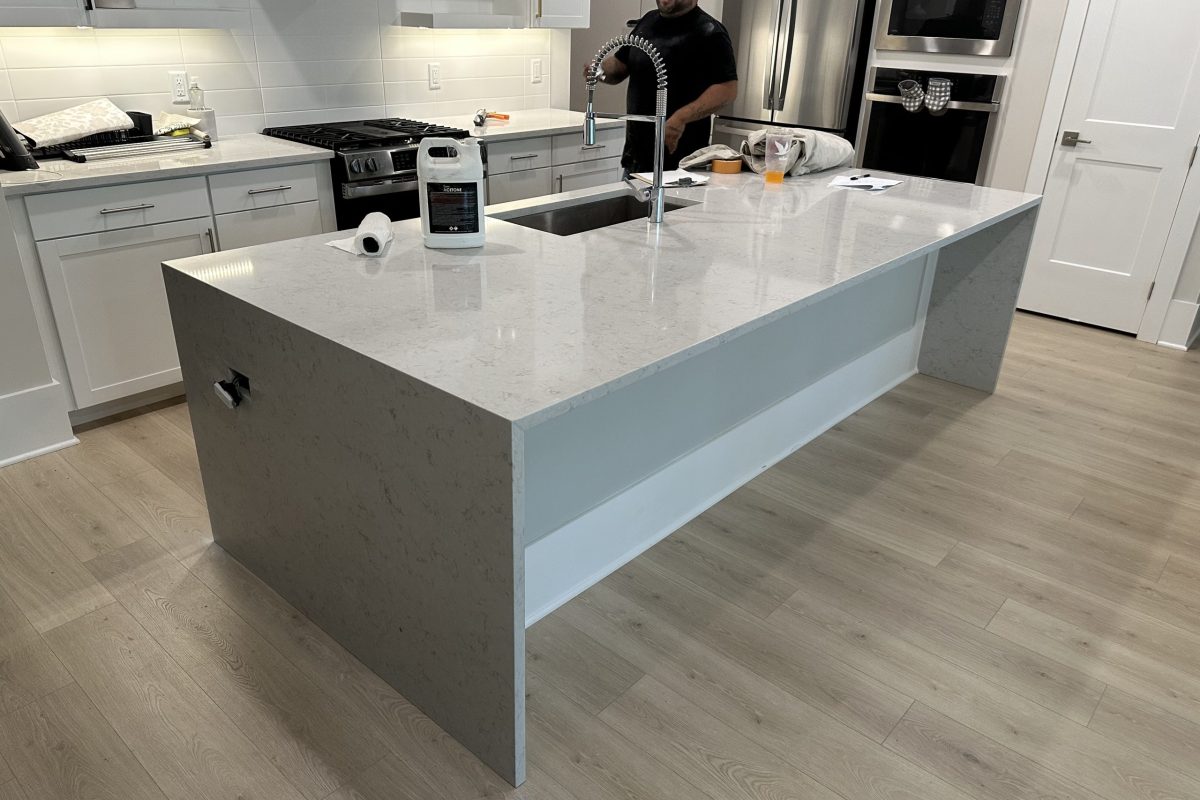
Waterfall countertops are a design feature of many modern kitchens. People love the way they look and how they protect the cabinetry beneath them. No matter what kind of stone countertop you have– marble, granite, quartzite, quartz, or any other stone– a waterfall countertop design is both functional and gorgeous.
What Is A Waterfall Countertop?
Waterfall countertops are frequently seen on kitchen islands, but can work with other cabinet styles if there’s an exposed edge. Unlike traditional countertops that end at the cabinet edge, waterfall designs extend vertically to the floor, creating a “waterfall” of material that frames the cabinetry below. The trick is creating a visual flow between the slabs’ veining and pattern so that the waterfall illusion isn’t broken up by mismatched patterns or a large, unsightly seam.
What Are The Best Stones For Waterfall Countertops?
You can use any countertop stone for waterfall countertops, but quartz is extremely popular for waterfall countertop installations. There are two very good reasons for this. First, quartz is manufactured, not naturally formed, which means that you don’t have to worry about finding slabs that match. Instead, they are often made to match. Second, quartz is much lighter than other countertop stones because it’s made from powdered quartz reconstituted with resin. That makes it easier to handle during installation without sacrificing durability or aesthetics. However, any countertop stone can be made into a waterfall edge, so if you prefer granite, marble, or quartzite, go with the stone you love and don’t feel like you are limited to quartz!
Waterfall Countertop Installation
Achieving a flawless waterfall countertop installation requires precision and expertise. The stone slabs must be meticulously measured, cut, and aligned to ensure the countertop and vertical panels form clean, continuous lines. Mitered edges, where the horizontal and vertical pieces meet at a seamless right angle, are carefully crafted to maintain the stone’s natural grain pat